Showing posts with label SGA. Show all posts

Sunday, April 3, 2011

President Elect Pizza Calls for Genocide Trial of Elections Commissioners

Courtesy of our trans-dimensional bureau X-43.

Bizzarolando, Florida – In the past week the University of Corner Florida has been the site of one of the most horrific scenes of ethnic cleansing in the history of the Confederate States of America. Millions of pizza peoples were shipped from their native strip malls within thirty minutes or less, to concentration camps erected throughout the campus. Whereupon they were chopped into slivers while still warm and feed to vicious roving gangs of starving students. The pitiless student population tore into their cheesy flesh leaving trails of sauce and shredded toppings in their wake. Work crews are still searching for survivors amidst the many discarded camps and mass pizza box pits.

Transport Containers for Pizza People extracted from a Student Union mass grave by international aid workers.

University of Corner Florida President-Elect Papa J. Pizza has issued a statement calling upon the International Criminal Court to try Elections Commissioner Hasen Relkcem on charges of genocide, ethnic cleansing, and criminal douchebaggery. In a statement from a recent speech given by President Pizza he called on the international community to band together to ensure that this tragedy does not repeat itself. “My people’s flesh may be delectable when freshly baked, our tasty toppings may bring all the boys to the yard, but this does not excuse the mass munching of our people”, said President-Elect Pizza. “We must find Relkcem and snack upon him, as he did snack upon us.” When asked by reporters whether retribution was called for instead of conciliation and understanding, President-Elect Pizza responded by calling the press core “utterly useless pussies” and instructed them to “suck [his] salty sausage”.

Remains of a pizza person found near the business administration region.

Commissioner Relkcem has fled to the Towers where he is amassing an army of SGA campaigners and establishing training camps around the stadium to wage jihad upon the pizza tribes. In a taped interview sent to the Corner Florida Future Relkcem made the following statement, “It is the will of the great Election that we subjugate every pizza, and sacrifice them to ensure the success of this most holy of rituals and campus Traditions”. In response to pressure from the International community Elections Commissioner Relkcem warned that, “Any opposition to the will of the Election will be met with my mighty army of campaigners occupying the Student Union and waging a never ending presidential campaign”, adding “So chew on that, bitches.

Elections Commissioner Hasen Relkcem in taped interview with the Courner Florida Future

This Thursday the senate will be considering a motion brought by President-Elect Pizza’s supporters to institute a no-fly zone over the union alongside preparations for a full scale invasion of the Towers. Opponents of the proposal note the decade long war against trees and the occupation of the arboretum. Senator Amtt Sobra is skeptical of military intervention and noted the continuing costs of the current wars waged by the student government. “Do you know how many trees there are in the arboretum? Shitloads, literally shitloads.” Senator Sobra continued, “We’ve already spent enough in blood and bullion killing insurgent Oaks and their hippie supporters. How many more have to suffer splinters and ticks in that struggle alone? We just can’t afford it anymore.” If the motion is successful, forces could be deployed to the North Eastern campus as soon as next Monday. The trans-dimensional bureau X-43 of the Vanguard Voice will continue to report upon this story as it develops.

Wednesday, March 30, 2011

2011 UCF Presidential Election Results or The Battle of Who Could Care Less

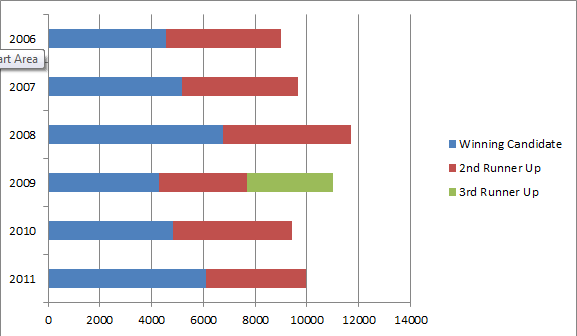
March 30th, 2011 – After the three days of campaigning, the winners of the food fight emerge.  Your new president is Mathew McCann, who will be sworn in with vice president elect Adam Brock.  In total 10,237 students voted in this election, with 6,105 votes going to the victors, 3,875 votes going to Nicholas Gurney and Fernando Gonzalez, and additional 257 votes going to write-in candidates.  After years of runoff elections and down to the wire votes this is the most lopsided vote in the last five years with a tally of 59.6% to 37.9% to 2.5%.

Figure 1: Ass-Whooping Redefined


 The total number of votes cast represents about 18.2% of the total student population.  This kind of voter turnout pales in comparison to even Afghanistan (http://bit.ly/gnwGie), a place where historically votes are more likely to be inscribed on bullets than ballots.  Granted this is probably in part due to the UCF student instinctively realizing that neither presidential candidate will have much power to do anything nor, more importantly, would try to mount a resistance anyway.  More on that, but let us look at the more important votes of the evening after the break.

Figure 2: Approximate Vote Counts Over the Last Six Presidential Elections

Figure 3: OMG, you just made Lady Liberty Cry.  At worst you're dodging douchebags around the Student Union, not daisy cutters in the desert!


At 7,866 votes, representing 89.19% of respondents, UCF students overwhelmingly voted for a constitutional amendment which would require the UCF president to respond within 15 weeks to any legislation that has been vetoed by the Senior Student Affairs Officer.  What is important about this is that it is an attempt by SGA to actually stand up to the administration, albeit very weakly.  The student senate debated for quite some time about how long they should wait for an opinion from the $500,000+ man.  A proposal of 8 weeks was rejected as being to bold, because President Hitt has more important things to do then read a bill voted on by student representatives. We obviously do not pay him enough to read pieces of legislation which are on average an entire one page long and then make a decision on what he read.  Dealing with students at a forum once or twice a year is work enough.  What do we expect from a man whose salary is on par with an entire department?


The problem with this amendment though is simple.  After the Senior Student Affairs Officer (currently Vice President Maribeth Ehasz) unilaterally vetoes a bill, the senate has to override the veto before it goes to the UCF president.  Regardless of how long Hitt takes to respond, he can still confirm the veto and students have absolutely no recourse.  This is the big untold secret of student government, as it really makes it simply a means of the administration appearing to appease student concerns.  At least now Hitt can’t simply ignore the issue and wait for students to graduate, hoping to duck any controversy entirely.


The second constitutional amendment to pass was one which requires the president and vice president to give a report to senate each semester detailing which committees they’re on and what they’re doing.  This passed with 8,253 votes, representing 93.04% of the respondents.  Essentially this appears to have gestated from senate’s rivalry with (now) former president Kilbride, mostly over his decision to keep the Knightmare fiscal database within the hands of the comptroller and a few financial committee chairs.  For the most part this amendment does little except provide slightly more transparency (mostly to senate representatives anyway).  This decision is probably a good thing in the long run, but nothing to get excited over.

However the third question on the ballot was probably the only reason to vote (considering the senate’s inability to pass the racial profiling referendum).  This question had to do with student concerns over protecting about 7.85 acres of arboretum land that the UCF administration is currently reviewing the status of with the St. John’s Water Management District.  This move most likely indicates that they are intending to use the land for construction of some kind.  Several environmental groups have already been working on the issue and reaped the rewards of 7,854 students, of which 87.81% respondents voted to support the continued preservation of the nearly eight acres of arboretum land.

Unlike the first constitutional amendment, students have made a clear stand in support of the continued conservation of the arboretum despite the possible designs to the contrary.  The student groups working to protect that land can now claim the support of an overwhelming majority of involved UCF students.  This makes it more difficult for university officials to simply build on that land without facing a potential PR nightmare.  This is definitely a victory for the UCF environmental groups who are working to protect the arboretum.

Unfortunately, the presidential elections don’t appear to have really been worth all the pizza shed for the cause.  Neither ticket had student leaders who had any history or even stated intent of challenging the lack of student representation on this campus.  Both tickets are very much connected to fraternal organizations with two of the candidates serving in leadership roles within the Interfraternity Council, of which Adam Brock has served as president.  Unfortunately, this will probably only exasperate the fraternal hold over the student government which has done more to represent the UCF administration rather than the 90% of non-fraternal students.   
All four candidates had experience in various positions within SGA, and not much to show for it.  The winning candidate hails from the most useless branch of student government, the judicial branch.  The only time the judicial branch is let out of the closet is to investigate the possibility of excusing parking tickets.  In his resignation speech, Mr. McCann attempted to defend the branch he lead with the mock trials they held, using an example of a trial involving the theft of a chocolate quiddich egg from Hogwarts, effectively arguing against the importance of the judiciary in its current form.  The vice-president’s major achievement was negotiating knight-lynx.  A somewhat successful initiative to partner with lynx to expand public transport.  Unfortunately, this initiative is mostly to local bars at late hours earning the knight-lynx buses the dubious nickname of “drunk busses”.

More disturbingly neither candidate made any mention of the upcoming budget cuts.  The $3.3 billion budget cuts being proposed in the Florida legislature to set to devastate statewide K-20 education.  Such budget cuts will greatly threaten everything the university does, not to mention forcing a dramatic increase in tuition.  Such an increase would only be able to be fought off by dedicated student leaders, willing to stand up to both the state government and the UCF administration.  It’s unfortunate for us that it looks like we don’t have such leaders.

Sunday, March 27, 2011

Introduction to the SGA Nomenklatura: The Senate Leadership Council

For those with any experience with the Student Government Association at our university, one of the most salient points that one comes away with is the extremely insular nature of the institution. Despite being elected by the student body, the student senate is no exception to this malady. For all the talk of wanting to “reach out to” students to “engage” them, there are mechanisms in place to defeat any attempt at opening the institution outside the SGA family. One of the most odious of these is the Senate Leadership Council, senate’s own means of creating its own poor man’s attempt at emulating the soviet nomeklatura.

On paper the SLC is a mentorship program, meant to initiate people into senate with mentors and via assigning the mentored students with duties to teach them how senate is to work. The SLC program is outlined in Senate Rule IX, which can be viewed here http://bit.ly/gw9TQ2. The SLC is a selective membership organization overseen by the legislative assistant, and limits its membership according to the decision of the aforementioned assistant and the ad-hoc committee that oversees it. If you think that this sounds an awful lot like a fraternity, you wouldn’t be the only one with that perception. Members of senate (largely fraternal in background) have a hard time discerning between the two. There are constant jokes relating SLC members to pledges, and even an incident in which the speaker of the senate almost referred to these members as “littles” on the senate floor (a fraternal term for a mentored person who is referred to as a little brother or sister).

Beyond the attempt to instill a fraternity within a legislature meant to represent 90% of the student body that isn’t involved in “Greek life”, is the more dubious purpose of SLC. The Senate Leadership Council acts as means to stifle opposition to the senate majority by replacing retiring senators with yes-men handpicked by senate leaders. More than five members appointed to the 43rd senate alone hail from the SLC, representing the majority of the replacements confirmed by senate. Despite their lack of experience, understanding of governance, goals, and actual approval by the student body, these students are consistently rubber stamped into senate seats.

In contrast, when former student senator, chair, and presidential candidate Austin Smith was up for appointment he was rejected by the senate. Despite the fact that Mr. Smith had ran for one of the then 5 empty graduate senate seats unfilled at the end of the election (now six empty graduate college seats). By all rights Mr. Smith and the other graduate candidates should have been placed in one of those many empty seats when there were no other contenders for them at the end of the fall ‘10 election session. However, he was rejected in a noxious display of hypocrisy when notoriously corrupt senator Jeremy Pozin argued that Mr. Smith’s political campaigns with the Students for a Democratic Society were too radical for him to be considered a viable appointment. This was in blatant violation of statute IX, 1101.13 which requires that senate pick appointments on qualification rather than political ideology (see: http://bit.ly/i4KaeO). Not to mention this was in addition to Pozin’s own drunken escapades while in an official SGA capacity. Mr. Smith was unable to break the two-thirds threshold for appointments, displaying the priority of a senate more concerned with fraternal allegiance and personal politics than in representing the students.

There have been suggestions in the past emanating from the progressive wing of Senate that SLC should be opened up to all students by eliminating the arbitrary cut off and selective membership procedures. These very reasonable calls to modify SLC have been answered by the inane concern that without the limit SLC would be unable to pay for all the polo’s and informational folders which were (laughably) considered critical for the functioning of the organization. The calls for such reform were dropped as many progressive senators left in disgust with the current senate and were replaced with SLC “littles”.

The current Senate Leadership Council is an abomination, and should be immediately reformed or discontinued. In its current form it serves as a blatant means of maintaining a political pH that is in line with the senate leadership’s views and its fraternal nature, rather than the actual views of the student body. There is no logical reason why a senate so supposedly hungry for student involvement would go to such lengths to restrict membership in an organization meant to model future student leaders. It’s time to call for the end of the SGA’s petty nomenklatura.

Tuesday, March 8, 2011

Senate Profiles in Prolonging Racial Profiling Debate

March 3rd, 2010 – Last Thursday the UCF student senate met to finally discuss topics that ventured outside the well-worn territory of spending money and into the realm of actually representing students on non-fiscal issues they’re concerned about. Although ignored by both the student paper of record and the noted campus tabloid, we feel it is our duty to relay to the student body this until now uncovered story. Members of the Progressive Caucus of the College Democrats introduced Resolution 43-23, authored by Senator Brittany Lane and caucus Representative Ali Kurnaz. The resolution debated that evening called for a referendum to be held during the presidential election. This referendum was to poll student opinion on legislation accused of promoting racial profiling in regards to immigration policy, based on two bills currently passing their way through the Florida legislature, Senate Bill 136 and House Bill 237.


These bills were modeled on last year’s highly controversial Arizona legislation, SB 1070. Passed by the Arizona Republican legislature and signed by Governor Jan Brewer, the law requires law enforcement officials to verify that all individuals who are legally stopped or arrested are U.S. citizens. Those without valid ID can be detained and ultimately deported. Also the bill contains a provision making it easier for people to sue any division of the state government if they feel that they are not doing enough to enforce immigration law. The problem with the legislation is that there are concerns, particularly among the Hispanic community, that the legislation would lead to an increase in racial profiling. Even though racial profiling is specifically banned in both the Arizona and Florida laws, a clause in the legislation requires law enforcement officers to verify immigration status of anyone they suspect to be in the country illegally, a condition that some commentators feel could easily lead to profiling based on race and/or socio-economic class. In addition, law enforcement faces potential fines for enforcement “…less than the full extent permitted by federal [immigration] law”. If found in non-compliance a division of the state can face a fine of no less than $500 to no more than $5,000, per day they were deemed by a court as not fully enforcing immigration law. As such, it has been argued that there is sufficient pressure to cause law enforcement to make racially motivated decisions on who to inspect.


However, the merit of the Florida copycat legislation was not the issue. In light of the controversy the progressive caucus was looking to elicit the opinion of the student body by having the following question on the ballot:


Do you support or not support the State passing legislation that mandates local law enforcement agencies to detain individuals through techniques that have raised concerns of racial profiling in similar legislation, in order to verify immigration status?”


The debate over the resolution began at 20:30 and lasted for a little over forty minutes. Several members of the senate expressed concern over what they viewed as the biased nature of the question. This argument was advanced by Pro-Tempore Miller and Deputy Pro-Tempore Hardman, along with several other senators who argued against advancing the resolution in its present form. Pro-Tempore Miller also raised concern that this legislation was not appropriate as he felt it did not adequately affect the student population. The debate intensified when Senator Evans made a motion to amend the question removing any mention of concern over racial profiling.


This provoked a response from members of the progressive caucus and the Governmental Affairs Committee members, who worked together to author the legislation. These participants, including Chair Hellinger and Senator Lane, argued that the entire purpose of the referendum itself was to raise the concern over racial profiling, not the enforcement of immigration policy. They felt that removing any mention of racial profiling would completely miss the point of the legislation. The motion narrowly passed through senate despite the protest of the presenters. At this point the introducers of the bill noted that it no longer served any useful purpose as the language had so radically changed. After Senator Lane consulted with members of the progressive caucus, a motion was made to remand the resolution back to the Governmental Affairs Committee for rewording.


Despite concerns by some of the presenters over the possibility of passing the resolution in time for the presidential election, it appears that it would be possible for the resolution calling for the referendum to be passed through two readings on the next senate meeting on March 17th. That is, if the senate finds the new language more palatable. Why is it that it’s so important to have the resolution passed before the presidential elections? The concern is that it costs several hundred dollars to run any election due to the cost of having to pay election commissioners. Since there would already be election commissioners being paid for the presidential election, there would be no need to pay for an additional election. Also, the greatest turnout is historically during the presidential elections, thus providing the largest possible sample size of UCF students.


According to Senator Lane of the Governmental Affairs Committee, Chair Hellinger is planning on convening an emergency meeting of the committee on Wednesday, March 16th, the day before the next senate meeting. In the meantime, Mr. Kurnaz and the progressive caucus of the UCF College Democrats are organizing a petition campaign to show student support of the referendum at the re-introduction of the resolution to call for the referendum on racial profiling. You can view & sign the petition, and see the updated form of the question currently under consideration, at http://bit.ly/i8cpqs.


Although other campus news agencies consider this story of little import, the Vanguard Voice considers this to be an important issue. Our writers and editors feel that student representation is one of the most pertinent issues at the University. We will continue to keep you informed on this story as it develops.